Who gets wrongly flagged
Why human writing gets flagged as AI
False positives are not random noise. They fall predictably on particular groups of writers — and the reason is built into what detectors measure, so it will not be fixed by a better model.
The mechanism
Detectors punish plain writing
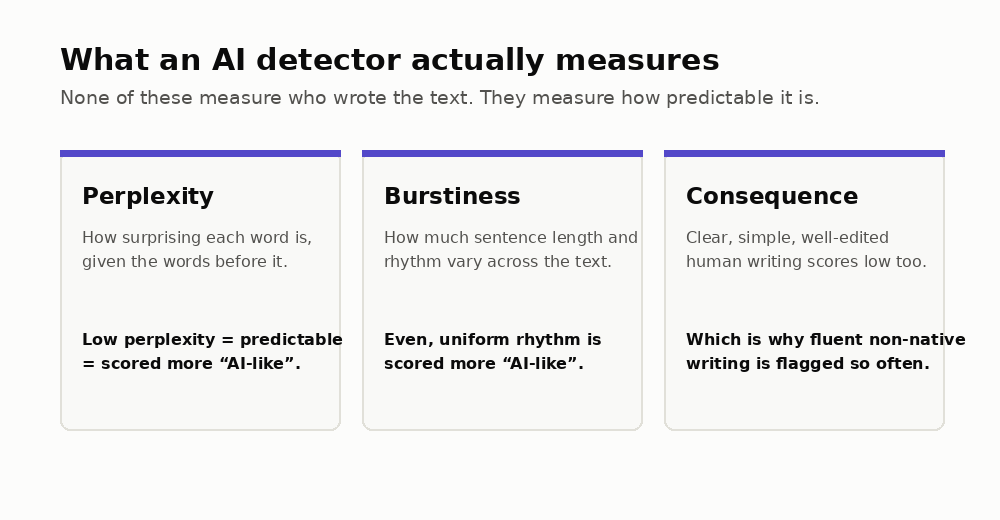
A detector estimates how predictable your text is. Predictable text scores as machine-like. That single design decision produces every pattern below, because plenty of humans write predictably for reasons that have nothing to do with AI.
The clearest demonstration comes from the 2023 Stanford study. Researchers took human-written essays by native English speakers and simplified the language. Misclassification rose from 5.19% to 56.65%. Same authors, same authorship, no AI involved — just plainer words.
Who is affected
Five groups that get flagged disproportionately
Non-native English writers
The largest documented effect. Seven detectors averaged a 61.22% false-positive rate on human-written TOEFL essays, against 5.19% for native-speaker essays. A smaller active vocabulary and steadier sentence rhythm read as machine-generated.
Writers taught to be concise
Technical writers, lawyers, engineers, scientists and journalists are trained out of stylistic variation. The clarity that makes their writing good is the uniformity a detector scores as artificial.
Formulaic genres
Lab reports, method sections, case notes, structured abstracts and legal boilerplate are supposed to be repetitive. Genre conventions constrain word choice and sentence shape, which drives perplexity down.
People who use writing aids
Grammar checkers, spellcheck, style suggestions, autocomplete and translation tools all smooth text toward the predictable. Using Grammarly on your own sentences can move you toward a flag.
Neurodivergent writers
Some autistic and ADHD writers produce highly consistent structure, repeated connective phrasing or unusually even paragraph rhythm. These are stylistic fingerprints, but they sit exactly where detectors look for machine output.
The uncomfortable implication
The bias is measurable in both directions
The Stanford team ran the experiment symmetrically, and both halves matter:
- Making non-native essays more linguistically complex dropped the false-positive rate from 61.22% to 11.77%.
- Making native-speaker essays less complex raised misclassification from 5.19% to 56.65%.
Authorship never changed in either direction. Only the surface complexity of the prose did. That is close to a controlled proof that these tools measure style, not origin — and that the group most likely to be harmed is the group already at the most disadvantage in an English-language institution.
Last reviewed: 14 August 2026. We update these pages when detector vendors change their claims or new peer-reviewed evidence is published.
FAQ
Common questions
Can grammar tools like Grammarly cause an AI flag?
They can contribute. Grammar and style tools push text toward more conventional, predictable phrasing, which is exactly what detectors score as machine-like. Using them is not misconduct under most policies, but it can move your text toward a higher score.
Are non-native English speakers really flagged more often?
Yes, and the effect is large. Published testing across seven detectors found a 61.22% average false-positive rate on human-written TOEFL essays versus 5.19% on native-speaker essays. Increasing the linguistic complexity of the same non-native essays cut the rate to 11.77%.
Does writing more simply make me more likely to be flagged?
Based on the available evidence, yes. When researchers simplified essays written by native English speakers, detector misclassification rose from 5.19% to 56.65% without any change in authorship.
Should I deliberately write in a more complex way to avoid flags?
We would not advise writing worse to satisfy a flawed tool. Clarity is a virtue and the problem is the detector, not your prose. If you are in an environment where scores carry consequences, the more durable protection is keeping drafts, version history and notes that evidence your process.