Practical steps
You've been flagged by an AI detector. What now?
A detector score is a statistical signal about text, not evidence about you. If you wrote the work, the goal is to shift the conversation from a percentage to your actual process — and to do it without destroying the evidence that proves it.
In order
Six steps, starting with the one people get wrong
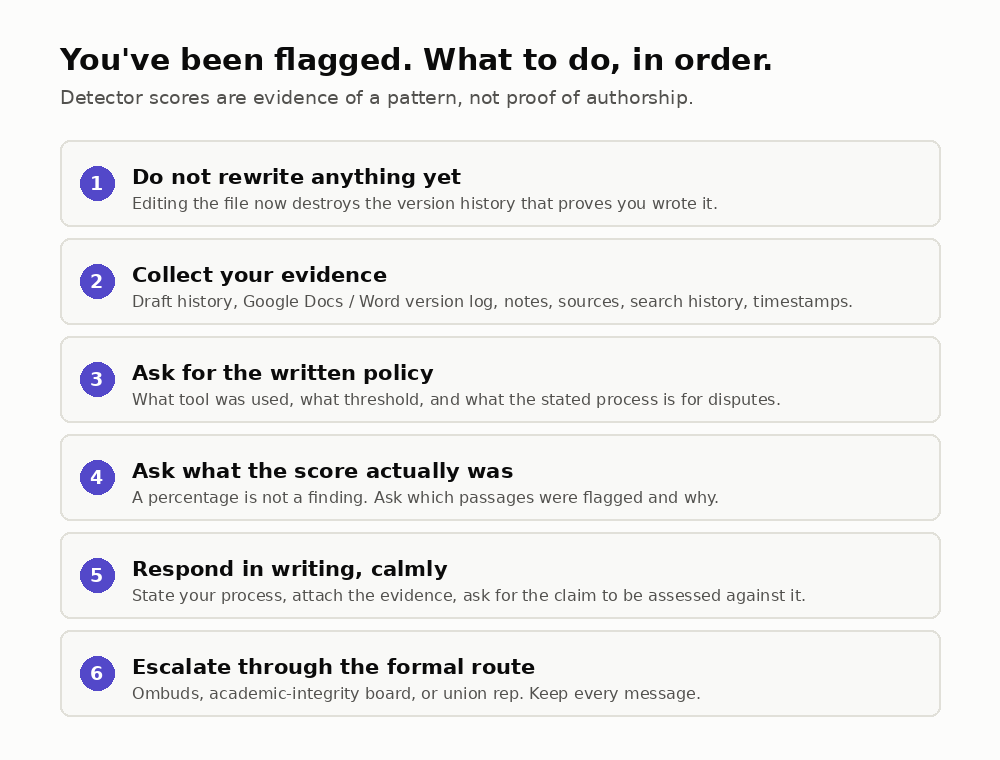
1. Do not rewrite anything yet
The instinct is to open the file and change it. Don't. Your document's version history is the strongest evidence you have, and editing now contaminates it. Take a copy if you need to work, but leave the original untouched.
2. Collect your evidence before you reply
Google Docs version history, Word's revision log, drafts in email or cloud backups, handwritten notes, library or database access logs, browser history for your sources, timestamps on outlines. Export or screenshot anything that could later be deleted or auto-purged.
3. Ask for the written policy
Which tool was used, what score threshold triggers a review, what the stated process is, and what right of reply you have. If a policy does not exist in writing, that is itself relevant. Ask by email so there is a record.
4. Ask what the score actually was — and on what
"87% AI" is not a finding. Ask which specific passages were flagged, what the tool's documented false-positive rate is, and whether any evidence beyond the score exists. Many cases collapse here, because there is nothing else.
5. Respond in writing, factually, without apologising for work you did
Describe your process, attach the evidence, and ask for the claim to be assessed against it. Do not admit to something you did not do to make the situation go away — an accepted allegation is much harder to undo later.
6. Escalate through the formal route if needed
Academic-integrity board, ombuds office, student union, or your union rep at work. Keep every message. If you are a student, ask whether you can be accompanied to any meeting.
Evidence checklist
What actually persuades a reviewer
Version history
The single most convincing artefact. A document that grew over hours or days, with false starts and revisions, is very hard to fake and easy to inspect.
Research trail
Sources you read, when you accessed them, notes you took. It demonstrates the thinking behind the text rather than the text itself.
Your other writing
Earlier work from before the tool existed, or written under supervision, establishes your natural style — useful when a reviewer claims the piece "doesn't sound like you".
The published evidence
The false-positive data on detector accuracy, and on who gets wrongly flagged. If you are a non-native English speaker, this is directly relevant to your case.
If you did use AI
An honest note
If you did use AI in a way your policy prohibits, none of the above is a defence strategy and we are not going to pretend otherwise. The realistic path is disclosing early, understanding the actual penalty rather than the imagined one, and asking what remediation is available. Institutions generally treat early disclosure very differently from a contested denial that later fails.
If you used AI in a way your policy permits — brainstorming, grammar, translation, structuring — say exactly that, and point to the clause. Permitted assistance is not misconduct, and a detector cannot tell the difference between permitted and prohibited use.
Last reviewed: 14 August 2026. We update these pages when detector vendors change their claims or new peer-reviewed evidence is published.
FAQ
Common questions
Can I be failed based only on an AI detector score?
Policies vary by institution and employer, but a growing number explicitly prohibit using a detector score as sole evidence. Vanderbilt University disabled Turnitin's AI detector entirely in 2023. Ask for the written policy and for any evidence beyond the score.
What is the strongest evidence that I wrote something myself?
Document version history. Google Docs revision history and Word's tracked versions show the text accumulating over time with edits and false starts, which is extremely difficult to fabricate and straightforward for a reviewer to check.
Should I rewrite the flagged text to lower the score?
No. Rewriting after an allegation destroys the version history that would have supported you, and a lower score on a rewritten document proves nothing about the original. Preserve the file as it is.
Does using ChatGPT for grammar or translation count as cheating?
It depends entirely on the policy that applies to you, and policies differ widely. Some permit grammar and translation assistance explicitly, others prohibit any AI involvement. Read the specific wording, and if it is ambiguous, ask in writing before submitting.
What if English is not my first language?
This is directly relevant and worth raising. Published testing found detectors wrongly flagged 61.22% of human-written TOEFL essays, compared with 5.19% for native-speaker essays. Bring that evidence to any review.